
- Your cart is empty
- Continue shopping
-
 Pixis Visibility Service
 - Posted on
- Categories:Uncategorized
- 0 comments


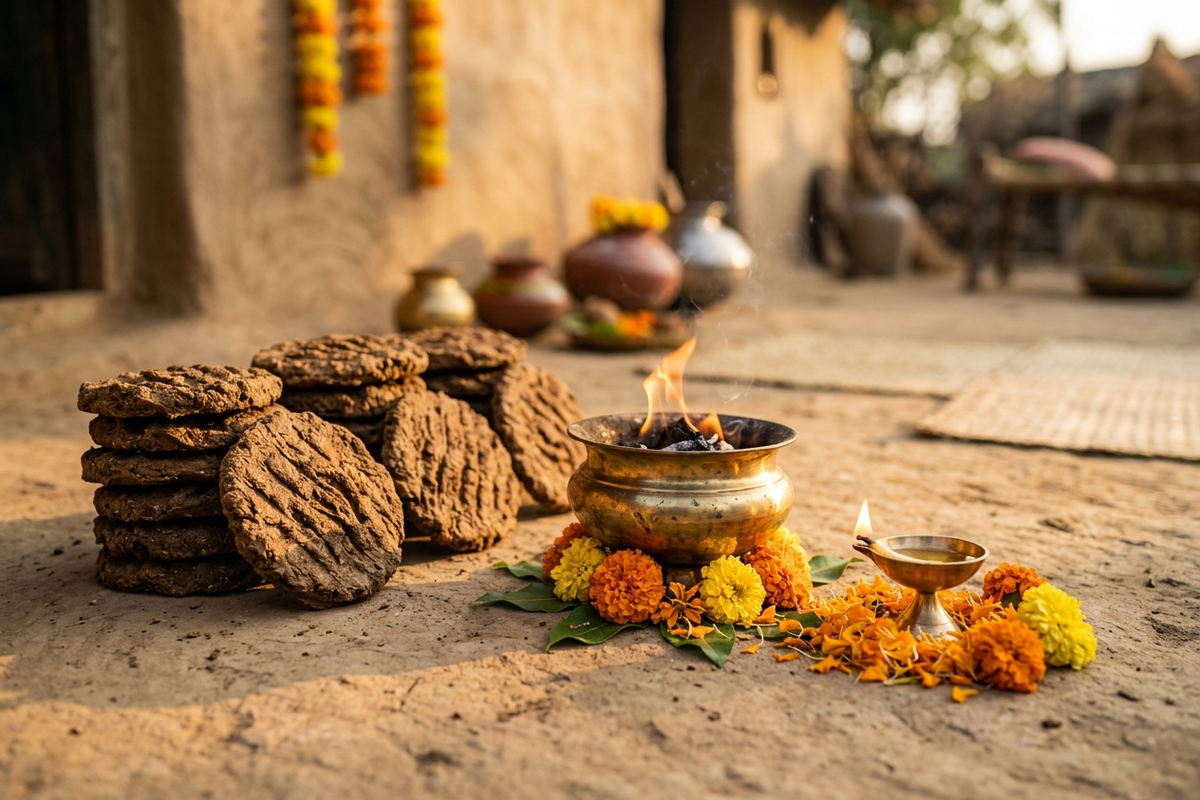
Cow dung cakes are handmade patties formed from cow dung mixed with straw, hay, or paddy husk. Shaped into flat rounds and dried under the sun, these preparations have served Hindu households for centuries as both practical fuel and sacred ritual material. The Sanskrit root “go-var” translates to “cow’s blessing,” a name that reflects the deep reverence with which these cakes are regarded in Vedic tradition.
Across India, cow dung cakes go by many regional names: upla in Hindi-speaking regions, kande in Maharashtra, gobar upla in parts of North India, gosse in Karnataka, and thepdi in some areas of Gujarat and Rajasthan. Among the various breeds of cattle in India, the dung of desi cows, particularly indigenous breeds like the Gir cow, is considered especially sacred and potent for ritual purposes. This raises a question many seekers ask: What are cow dung cakes used for in Hindu rituals and what are their traditional religious applications? The answer spans a remarkable range of practices, from sacred fire ceremonies and space purification to astrological remedies and festival celebrations.
Religious and Spiritual Significance in Hinduism
In Hindu tradition, the cow is revered as Gau Mata, Mother Cow, and is believed to embody all deities. The Sanskrit phrase “sarva devata mayi gau” captures this belief: the cow contains within her the essence of every god and goddess. Vedic texts associate the cow with Aditi, the mother of all gods, linking her to the very foundation of cosmic order. Because the cow herself is held sacred, every product she gives, including dung, is treated as a divine gift rather than a waste material.
Cow dung, or gomaya, is classified in Hindu scripture as pavitra dravya, a purifying substance. It carries protective and healing qualities that extend beyond the physical. When applied to surfaces or burned in ritual fires, gomaya is believed to cleanse the environment of negative energies and restore a sense of auspiciousness. This symbolism of purity, prosperity, and divine energy underpins every ritual application described in this article. Cow dung also represents fertility and abundance; just as the cow nourishes life through her milk, her dung is seen as extending that life-giving capacity into the soil, the home, and the sacred fire. In Hindu tradition, cow products are considered as pure as the waters of the sacred Ganges, a comparison that underscores their spiritual standing. For families who follow traditional practices, the presence of gomaya in the home is itself a source of blessing and protection.
At Goseva, our work with Gir cow gosalas since 1960 has reinforced our understanding of this sacred relationship. The indigenous Gir cow, with its distinctive hump and gentle disposition, produces dung that traditional practitioners consider especially potent for ritual use. Our state level award-winning cow trail and our commitment to empowering rural gosalas stem from this same reverence for Gau Mata and her gifts.
Sacred Fire Rituals: Havan, Yajna, and Agnihotra
The primary ritual use of cow dung cakes is as fuel for sacred fire ceremonies. In Hindu practice, fire is not merely a physical element but a divine messenger. Agni, the fire god, carries offerings from the human realm to the deities, making the quality and purity of the fuel itself a matter of spiritual significance.
Havan and Yajna
Havan and Yajna are among the most ancient Vedic rituals still practiced today. In these ceremonies, devotees offer ghee, herbs, and wood into a fire fueled by cow dung cakes. The upla serves as a steady, slow-burning base that sustains the sacred flame throughout the ritual. Offerings are made while chanting Vedic mantras, with prayers for blessings, health, peace, or specific intentions. The cow dung cakes, when burned with pure ghee, produce a sweet-smelling smoke that is believed to cleanse the air and create an atmosphere charged with spiritual energy.
In traditional settings, prasad, the sanctified food offered to deities and then shared among participants, is often cooked on fires made from cow dung cakes. This practice reflects the belief that fuel regarded as ritually pure helps maintain the sacred character of the offering. The cow dung fire is itself considered a sacred element of the preparation, not merely a heat source.
A simple how-to for a basic havan: place cow dung cake uplas in a havan kund, the square or circular fire vessel, light them with camphor, offer pure ghee into the flame, and then add havan samagri, a mixture of herbs and sacred substances, while chanting the appropriate mantras. The steady heat of the uplas allows the offerings to burn completely, fulfilling the ritual requirement.
Agnihotra
Agnihotra is a specific Vedic fire ritual performed at sunrise and sunset. It uses a small piece of cow dung cake, often called a gobar upla, to create a pure fire in a copper vessel. At the precise moments of dawn and dusk, offerings of rice and ghee are made into the flame while chanting specific mantras. Practitioners believe that Agnihotra balances energies in the surrounding environment and purifies the air. The timing is considered essential: practitioners understand the transition points between day and night to carry a unique spiritual potency, and the ritual is designed to align with those moments.
The choice of cow dung cakes as fuel for Agnihotra is not incidental. Traditional texts specify that the dung of a desi cow, dried and prepared with care, produces a fire that meets the ritual standards of purity. The smoke from the burning upla, combined with ghee, is said to carry a subtle fragrance that distinguishes it from ordinary fire.
Purification, Cleansing, and Astrological Applications
Purification of Spaces
Cow dung cakes play a central role in cleansing homes, temples, and ceremonial spaces. Burning them is believed to remove Vastu doshas, imbalances in the spatial energy of a building, and to balance the panchamahabhutas, the five elements of earth, water, fire, air, and ether. The practice of dhuni illustrates this application: a small piece of cow dung cake is lit with camphor and guggul or loban resin, creating a purifying smoke that is carried through every room. The smoke is believed to neutralize stagnant or negative energies and restore a sense of clarity and peace.
Beyond burning, cow dung has a long tradition of use as a coating for walls and floors. In rural homes across India, a fresh layer of cow dung paste is applied to earthen surfaces, a practice that serves both practical and spiritual purposes. The coating is believed to absorb malignant energies, purify the living space, and create a clean surface for daily activities and worship. The natural antimicrobial properties of cow dung also contribute to a healthier indoor environment, a fact recognized in Ayurvedic texts.
Astrological Applications
In Vedic astrology, cow dung cakes are used in havans performed to calm troubled planets. Specific planetary afflictions, particularly those involving Venus (Shukra), the Moon, and Jupiter, are addressed through fire rituals that use gobar upla as the base fuel. The belief is that the sacred fire, fueled by pure cow dung, carries the remedial offerings to the corresponding planetary deity, helping to reduce the negative effects of a difficult planetary period.
Remedies for Shani Dosha, the affliction associated with the planet Saturn, and for the evil eye, known as drishti, also incorporate cow dung cakes. In these practices, gobar upla is burned with specific herbs and resins to cleanse negative energy from a person or place. The ritual is often performed on a Saturday, the day associated with Shani, or during particular lunar phases.
Offering ghee into a cow dung fire during specific planetary times is believed to attract wealth and success. This practice aligns the purifying power of the sacred fire with the astrological timing considered most favorable for material and spiritual growth. Families who follow these traditions often consult a priest or astrologer to determine the appropriate timing and procedure.
Sacred Ash (Vibhuti/Bhasma) and Panchgavya Preparation
Vibhuti and Bhasma
Vibhuti, also called Bhasma, is sacred ash produced by burning cow dung cakes completely. The process is deliberate and careful: dried uplas are placed in a controlled fire and allowed to burn until only fine ash remains. This ash is then collected, sometimes sifted and prepared with additional ritual steps, and used for worship.
Vibhuti holds deep symbolic significance in Hindu practice. It represents detachment from the material world, the impermanence of physical existence, and the purity that remains when all else is consumed. Applied on the forehead in three horizontal lines, Vibhuti serves as a visible mark of devotion and a reminder of the divine presence. It is also applied to the arms, chest, and throat during certain rituals. The ash from cow dung is considered particularly potent because of the sacred nature of its source.
Panchgavya
Panchgavya is a sacred preparation made from five cow products: milk, curd, ghee, cow urine, and cow dung. Each component carries its own purifying and healing properties, and together they form a combination that is used in purification rituals, medicinal contexts, and as a sanctifying agent before worship.
The inclusion of cow dung in Panchgavya elevates it from a practical material to a sacred ritual ingredient. Panchgavya is used to purify the body and mind before worship, to sanctify ritual objects, and to create an auspicious and unpolluted sacred space. In some traditions, a small amount of Panchgavya is consumed as part of a purification ceremony, a practice rooted in the belief that the five cow products together restore spiritual and physical balance.
Panchgavya is also used to prepare the sacred space for ritual designs. Before creating a kolam or rangoli, the surface may be purified with a Panchgavya wash, creating a clean canvas for the sacred geometry. This practice reflects the belief that ritual art requires a sanctified foundation.
At Goseva, Panchgavya is at the heart of our product line. Our Panchgavya-based Ayurvedic products, including nasal drops and herbal powders, are made from the five sacred components derived from Gir cows. We follow traditional Ayurvedic methods and hold quality certifications for our genuine products, so that what reaches your home carries the same purity that tradition demands. Our products are crafted with no allergy and no side effects, reflecting our commitment to natural wellness rooted in heritage.
Cow Dung Cakes in Hindu Festivals and Special Occasions
Govardhan Puja (Diwali)
Govardhan Puja, celebrated the day after Diwali, is one of the most vivid examples of cow dung cakes in festival practice. Married women knead sacred sculptures from fresh cow dung, shaping them into representations of Mount Govardhan, the hill that Lord Krishna lifted to protect his people from a devastating storm. These sculptures are worshipped alongside images of Krishna and his cattle, honoring the divine protection of nature and the cow.
The tradition specifies that only married women knead the Govardhan sculptures, a practice that symbolizes fertility and prosperity. The act of shaping the dung with one’s hands is itself a form of devotion, connecting the worshipper physically to the sacred material.
Holika Dahan (Holi)
During Holika Dahan, the bonfire ceremony that marks the beginning of the Holi festival, cow dung cakes are included in the fire. The bonfire celebrates the victory of good over evil, commemorating the story of Prahlad and Holika. The inclusion of gobar upla in the Holika fire connects this celebration to the broader network of sacred fire rituals in Hindu tradition.
Diwali
During Diwali, cow dung is used for floor purification. A mixture of cow dung and red earth is applied to the floor, creating a clean and auspicious surface. After the floor dries, rangoli designs are drawn, and in some households, Govardhan sculptures are prepared for the following day’s puja. The use of cow dung in this context reflects the belief that it prepares the home to receive Lakshmi, the goddess of wealth, by making the space pure and welcoming.
Other Ceremonies
Cow dung cakes feature in numerous other Hindu ceremonies. Griha pravesh, the housewarming ritual, uses them in the first fire lit in a new home. Vastu puja, the ceremony to harmonize a building’s energy, incorporates them as well. Satyanarayan Katha, a popular worship narrative, and Navgraha Puja, the ritual to honor the nine planets, both include cow dung cakes in their fire offerings.
In daily pooja, many families light a small cow dung cake in their home altar to sanctify prayers. The steady, fragrant flame creates an atmosphere of devotion that marks the transition from ordinary time to sacred time.
Cultural and Practical Uses Beyond Rituals
Traditional Cooking Fuel
In rural India, cow dung cakes have long served as a cooking fuel. The chulha, a traditional household fire, burns uplas to prepare daily meals. The steady, even heat of cow dung cakes is well suited to slow cooking, and many traditional dishes depend on this specific type of fire.
Local breads like dal bati, a staple in Rajasthan and parts of Gujarat, are traditionally baked directly in cow dung cake fires. The flavor and texture imparted by this method of cooking are considered essential to the dish, and many families continue to prepare it this way even when modern stoves are available.
Natural Fertilizer
After ritual use, cow dung cakes are often scattered in fields as manure. This practice carries both practical and spiritual significance: the cakes enrich the soil with nutrients, and their use after a sacred ceremony is believed to bring good luck to the harvest. The cycle from ritual to field reflects the Hindu understanding of the cow as a source of both spiritual and material abundance.
Building Material
Cow dung mixed with mud has been used for centuries as a building material. Applied to walls and floors, the mixture provides a smooth, clean surface that cools the interior during summer months. The same properties that make cow dung a purifying agent in ritual contexts, its ability to absorb negative energies and its natural antimicrobial qualities, make it a valued material for home construction in traditional communities.
Historical Usage
According to NSSO data from 1993 to 2001, cow dung (dung cake) as a primary cooking fuel was historically used by only about 10 to 11 percent of rural households. The often-cited figure of roughly 90 percent rural usage refers to all traditional biomass fuels combined, including firewood, crop residue, and dung cake together, not cow dung alone. While biogas has emerged as a cleaner modern alternative for energy generation, the cultural and spiritual significance of traditional cow dung cake practices endures in both rural and urban Hindu households.
Frequently Asked Questions
What are cow dung cakes called in different regions, and how are they prepared?
Cow dung cakes are known by many regional names across India: upla in Hindi-speaking regions, kande in Maharashtra, gobar upla in parts of North India, gosse in Karnataka, and thepdi in some areas of Gujarat and Rajasthan. They are prepared by mixing fresh cow dung with straw, hay, or paddy husk, shaping the mixture into flat round patties by hand or using a mold, and drying them in the sun for several days until they harden completely. The drying time varies with climate; in humid regions the process can take longer than in dry ones.
Why is cow dung considered sacred in Hinduism?
The cow is revered as Gau Mata, Mother Cow, and is believed to embody all deities. Because of this, cow dung (gomaya) is classified as pavitra dravya, a purifying substance, and is considered as pure as sacred Ganges water. The sacredness extends to all cow products, which is why dung, urine, milk, curd, and ghee together form Panchgavya, a combination used for purification before worship.
Which specific rituals use cow dung cakes as fuel?
Cow dung cakes serve as fuel for Havan, Yajna, and Agnihotra, the Vedic sunrise and sunset fire ritual. They are also used in griha pravesh, vastu puja, Satyanarayan Katha, Navgraha Puja, Holika Dahan, and daily home pooja. In each case, the upla provides a steady, pure flame that carries offerings to the deities through Agni, the divine messenger. The choice of cow dung over other fuels is based on traditional texts that specify its purity for ritual fires.
How are cow dung cakes used in astrological remedies?
Cow dung cakes are burned in havans to calm troubled planets, particularly Venus (Shukra), the Moon, and Jupiter. For Shani Dosha and the evil eye (drishti), gobar upla is burned with specific herbs and resins, often on a Saturday or during particular lunar phases. The timing and the specific herbs used vary depending on the planetary affliction being addressed, and families typically consult a priest or astrologer for guidance.
How is Vibhuti (sacred ash) prepared from cow dung cakes?
Vibhuti is produced by burning cow dung cakes completely until only fine ash remains. The dried uplas are placed in a controlled fire and allowed to burn fully. The collected ash, called Vibhuti or Bhasma, symbolizes detachment and purity. It is applied on the forehead in three horizontal lines during worship as a mark of devotion and divine blessing. The process requires patience; incomplete burning would leave charred fragments rather than the fine ash needed for ritual use.
Conclusion
Cow dung cakes occupy a multifaceted role in Hindu ritual life. They serve as fuel for sacred fire ceremonies, as agents of purification for homes and temples, as astrological remedies for planetary afflictions, and as centerpieces of festival celebrations. From the havan kund to the Diwali floor, from the Agnihotra vessel to the Govardhan sculpture, gobar upla connects the practical and the sacred in a single, humble preparation.
At Goseva, we are committed to preserving these traditions through authentic Panchgavya-based products derived from Gir cows. Our 14+ years of experience working with a Gaushala that has operated since 1960, our quality-certified genuine products, and our support for rural gosalas and farmers all reflect our dedication to this heritage. We invite you to explore our range of Panchgavya-based Ayurvedic products, including Gir Cow Ghee made by the traditional Bilona method, Panchgavya soap, Gomutra Ark, and Ayur Ghee Nasya nasal drops, for your spiritual and wellness needs. These traditions remain as relevant in modern spiritual practice as they have ever been, offering a path to purity and connection that transcends the passage of time.
