
- Your cart is empty
- Continue shopping
-
Pixis Visibility Service
- Posted on
- Categories:Uncategorized
- 0 comments
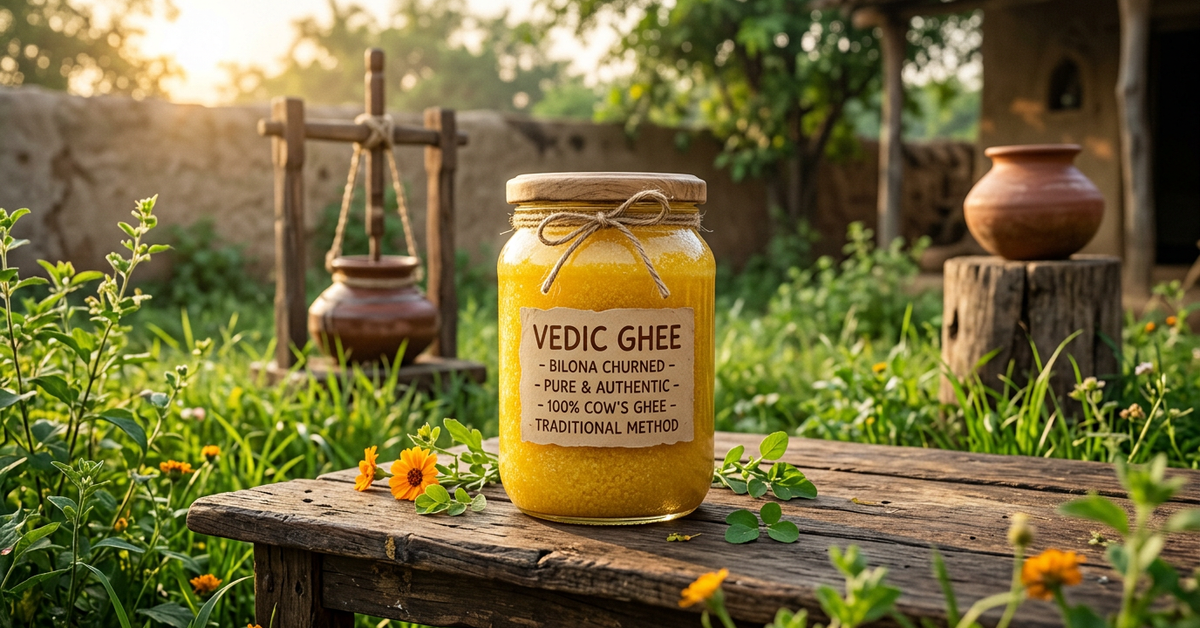
Finding genuine A2 Bilona ghee in a market flooded with industrial products requires more than a quick glance at a label. Many consumers are left wondering if their jar of clarified butter truly reflects the traditional Ayurvedic methods described in ancient texts or if it is merely a modern marketing label applied to a conventionally processed fat.
The distinction between authentic Vedic ghee and standard commercial variants goes far beyond price tags. It comes down to the source milk, the specific cattle breeds involved, and the time-honored manual processes used to create the final product. This guide walks through every layer of that distinction, from the biology of indigenous cows to the step-by-step Bilona method, so you can make an informed purchasing decision.
What Is Vedic Ghee? Understanding the Traditional Method
Vedic ghee refers to clarified butter produced using centuries-old Ayurvedic techniques that prioritize natural fermentation and manual churning. Unlike modern methods that separate cream from milk, this traditional approach begins with the whole milk of indigenous Indian cattle breeds, cultures it into curd, and then hand-churns that curd to extract butter for clarification.
Indigenous breeds such as Gir, Sahiwal, Rathi, and Kankrej show a very high predominance of the A2 beta-casein allele, with reported frequencies ranging approximately from 0.83 to 1.00, though A1 is not entirely absent in these populations. Crossbred Holsteins typically produce both A1 and A2 beta-casein, with the A1A2 genotype being the most common, rather than producing A1 exclusively. This genetic distinction in the source milk sets the stage for the nutritional profile of the final ghee.
The Role of Indigenous Breeds in Authenticity
The term ‘Vedic’ signifies adherence to ancient scriptures that prescribe specific labor-intensive steps for dairy processing. These methods are designed to retain the natural enzymes and beneficial fats present in cultured curd while removing lactose and casein during the clarification phase. The scriptural process stands apart from industrial shortcuts precisely because it preserves the cultured nutrient matrix that forms during fermentation.
According to industry data tracked by IMARC Group, the market for A2 ghee relies heavily on the distinct genetic makeup of these native cattle breeds to deliver the specific protein profiles valued by health-conscious consumers. know.organicmandya.com
True Vedic ghee reflects the entire lifecycle of the milk, starting from grass-fed animals in open pastures to the careful handling required to maintain its integrity before it ever reaches a churner. The sourcing environment, the breed of the cow, and the fermentation step all contribute to the final product in ways that mechanical cream separation cannot replicate.
Why Hand-Churning Matters More Than You Think
The Bilona process avoids mechanical separation entirely, so the butter extracted retains the full spectrum of micronutrients found in the original curd. This commitment to manual processing defines the highest tier of quality in the ghee industry today, and it is the reason traditional Bilona ghee commands a premium over industrially produced alternatives.
The Bilona Method: How Vedic Bilona Ghee Is Made
The Bilona method transforms pure A2 milk into ghee through a four-step ritual that depends on patient, manual work rather than mechanized efficiency. First, fresh milk is boiled and cooled slightly before adding a live culture to set it into thick curd. This fermentation step is what separates Bilona ghee from cream-based industrial ghee, and it is where much of the nutritional complexity originates.
Next, artisans hand-churn the solidified curd using a traditional wooden churner known as a ‘bilona’ to extract the butter. This physical agitation breaks down the curd structure differently than industrial centrifuges, releasing buttermilk while preserving the butter’s rich texture and cultured character.
Finally, the extracted butter is slowly heated over a wood fire or low flame until the milk solids settle and the clarified ghee rises to the top. This slow heating process concentrates the flavor and creates the characteristic nutty aroma associated with premium vedic bilona ghee. The entire sequence, from boiling milk to bottling ghee, can span several hours of careful attention.
The Milk-to-Ghee Yield Ratio Explains the Cost
Labor intensity directly impacts production costs because this method requires 28 to 30 litres of pure A2 milk to produce just one litre of finished Bilona ghee. The lower yield combined with the hours of manual work justifies the premium price point compared to industrial alternatives, which can extract ghee from cream in a fraction of the time and with far less milk input.
Industrial cream separation skips the fermentation step entirely, allowing manufacturers to process milk much faster but often stripping away the probiotic benefits and complex nutrient matrix found in cultured ghee. know.organicmandya.com The result is a product where every drop reflects the patience of the artisan and the purity of the source, offering a culinary experience that machine-made versions cannot match.
For buyers evaluating price, the milk-to-ghee ratio is one of the most concrete indicators of authenticity. A brand that claims Bilona processing but prices its ghee close to industrial cream-separated products may be cutting corners somewhere in the chain, whether in sourcing, fermentation, or churning.
Temperature Control Preserves Nutritional Integrity
Artisans monitor the temperature closely during the clarification phase to prevent overheating, which could degrade the delicate fatty acids and antioxidants present in the butter. This careful temperature management helps the final product retain its stability and nutritional value through the clarification process.
Vedic Ghee vs. Industrial Ghee: Key Differences
Understanding the gap between Vedic Bilona ghee and mass-produced alternatives helps buyers make informed decisions about their kitchen staples. The primary differences lie in the raw materials used, the extent of human intervention in the production process, and the resulting nutritional composition.
| Feature | Vedic Bilona Ghee | Industrial Cream-Based Ghee |
|---|---|---|
| Source Milk | Pure A2 Milk from indigenous breeds (Gir, Sahiwal) | Mixed A1/A2 milk or concentrated cream (Jersey/HF) |
| Process | Curd formation followed by hand-churning | Mechanical cream separation and direct clarification |
| Smoke Point | ~250°C (suitable for high-heat cooking) | ~250°C (stable at high heat) |
| Butyric Acid Content | ~3.5g per 100g | ~2 to 3g per 100g |
| Lactose/Casein | Nil (removed during clarification) | Nil (removed during clarification) |
Both types of ghee share a high smoke point around 250°C, making them suitable for sautéing and deep frying, yet the nutritional composition varies. Research indicates that Bilona ghee may contain higher levels of intact fat-soluble nutrients including vitamin K2 and conjugated linoleic acid, though the magnitude of these differences depends on sourcing and processing variables. know.organicmandya.com
The Transparency Gap in Labelling
Consumers must remain vigilant because the term ‘Bilona’ is not currently standardized or regulated by any government body. This means that not every product labelled ‘Bilona’ actually follows the traditional village-scale production methods described in ancient texts. deshwale.com Without a regulatory definition, the label alone does not confirm the process.
Marketing strategies often leverage premium branding with Sanskrit-inspired aesthetics to imply authenticity, sometimes masking industrial practices underneath. Verifying the brand’s sourcing claims and production transparency is the most reliable way to confirm you are getting a product that matches its labelling.
Why Price Alone Does Not Guarantee Quality
A ₹2,000 jar might seem superior to a ₹700 option due to its earthy packaging and ‘heritage’ messaging, but high prices do not automatically confirm traditional production methods. In some cases, the premium reflects better branding rather than genuine superiority in taste or nutrition. etvbharat.com The etvbharat.com article presents a cautious and skeptical view of artisanal and A2 ghee health claims, with expert Shefali Bhardwaj stating that these claims ‘aren’t strongly backed by solid clinical studies’ and that artisanal ghee’s nutrition is ‘broadly similar to regular, good-quality ghee.’ Buyers should weigh this perspective alongside traditional Ayurvedic reasoning when evaluating premium products.
Health and Wellness Benefits of Authentic Vedic Ghee
Authentic Vedic ghee is associated with potential digestive advantages attributed to the A2 beta-casein protein found in indigenous cow milk. While the clarification process removes proteins, many users report that cultured ghee feels easier to digest compared to regular butter or cream-based products. These reports are anecdotal and should be understood as user experience rather than clinically established fact.
In Ayurvedic philosophy, ghee serves as a medium for delivering herbs deep into the tissues, promoting overall immunity and skin health. Its role extends beyond being a simple cooking fat to becoming an integral part of daily wellness rituals. timesofindia.indiatimes.com Ayurvedic texts describe ghee as a carrier that enhances the bioavailability of herbal preparations, which is why it features prominently in formulations like Ayur Ghee Nasya, where Panchgavya ghee is used as a base for nasal drops.
The presence of butyrate, a short-chain fatty acid, is associated with gut health and reduced inflammation in nutritional literature, while omega-3 fatty acids contribute to brain function and cognitive clarity. However, as the etvbharat.com article reports, expert Shefali Bhardwaj notes that claims around artisanal ghee ‘aren’t strongly backed by solid clinical studies’ and that its nutritional profile ‘remains broadly similar to regular, good-quality ghee.’ The cultural and anecdotal evidence for these benefits remains meaningful within the Ayurvedic tradition, but buyers should be aware that the scientific evidence is not yet conclusive. etvbharat.com
Balancing Science and Tradition in Wellness
Naturopathy experts note that artisanal varieties may offer slightly higher levels of certain antioxidants compared to standard options, particularly when sourced from grass-fed herds. However, it is important to view these differences within the broader context of a balanced diet and to recognize that the scientific community has not reached consensus on the superiority of A2 or artisanal ghee. etvbharat.com The value of Vedic ghee may lie as much in the integrity of its production process and the transparency of its sourcing as in any single nutritional metric.
How to Identify Pure Vedic Bilona Ghee
Identifying pure Vedic Bilona ghee requires attention to detail and a willingness to research the brand behind the jar. Start by verifying the cow breed claimed on the label, looking specifically for Gir, Sahiwal, or other indigenous varieties associated with A2 milk production. A brand that names its breed and its sourcing region is providing more verifiable information than one that relies on generic terms like ‘desi cow’ or ‘pure ghee’ without further detail.
True Bilona ghee typically possesses a grainy texture upon solidification, a distinct golden hue, and a rich, nutty aroma that lingers on the palate. These sensory cues distinguish it from industrially processed versions, which tend to have a smoother, more uniform consistency and a less complex aroma profile.
Warning signs include vague sourcing information, lack of certification, or packaging that emphasizes buzzwords like ‘heritage’ without providing concrete details about the farm, the breed, or the churning method used. A brand committed to transparency will state its milk source, its process, and its quality certifications clearly.
Key Authentication Checklist
- Confirm the product uses the hand-churning Bilona method rather than cream separation.
- Verify certifications for organic status and A2 milk purity.
- Look for explicit mention of grass-fed sourcing and specific cow breeds like Gir.
- Check for transparent labelling regarding the milk-to-ghee yield ratio.
- Read reviews focusing on texture, color, and taste profile consistency.
At Goseva, we meet these authenticity criteria by sourcing exclusively from pure Gir cows in Gujarat and adhering strictly to the traditional Bilona process. Our products are quality certified as genuine, and our Gaushala has been operational since 1960, giving us over 14 years of direct experience in managing the full production cycle. You can review our sourcing and production practices in detail at gomataseva.org/best-authentic-gir-cow-bilona-ghee-brands-2026-goseva.
Why Goseva’s Vedic Ghee Stands Apart
Goseva distinguishes itself through a legacy of Gau Seva dating back to 1960, giving us over 14 years of hands-on expertise in managing our own Gaushala. This deep-rooted experience allows us to oversee every step of the process, from feeding the cows to bottling the final ghee. Our Gaushala has also been recognized with a state-level award for our cow trail, reflecting the care and attention that goes into maintaining our herd.
Our pricing of ₹1,400 to ₹1,800 per 500g reflects the genuine cost of the Bilona method and the premium quality of grass-fed Gir cow milk. The variation within this range corresponds to pack size and specific product line differences. This price stands in contrast to cheaper, industrially mass-produced alternatives that skip the curd-setting and hand-churning steps, and it is a direct function of the 28 to 30 litres of A2 milk required for each litre of finished ghee.
| Brand | Milk Source | Method | Price Range (Approx. per 500g) | Transparency |
|---|---|---|---|---|
| Goseva | Pure Gir (A2), Grass-Fed Gujarat | Hand-Churned Bilona | ₹1,400 to ₹1,800 | Quality certified genuine products; Gaushala since 1960; state-level award |
| Amul / Major Brands | Mixed Breeds / Commercial Herd | Industrial Cream Separation | ₹500 to ₹800 | Standard labeling |
| Generic Premium Brands | Unclear Mixed Sources | Often Machine Churned | ₹800 to ₹1,500 | Variable / Limited info |
| US Import Brands | Mixed Imports | Industrial Processes | $15 to $25 USD | Import certification only |
Unlike brands that rely on imported milk or ambiguous sourcing, we provide quality certified genuine products backed by a Gaushala operational since 1960 and a state-level award-winning cow trail. This dedication to verifiable production practices makes our Vedic ghee a trusted choice for those seeking authentic Ayurvedic products. You can read a detailed review of our sourcing and pricing at gomataseva.org/is-goseva-bilona-a2-ghee-authentic-worth-the-price.
We also support rural gosalas and farmers, so our business model empowers the very communities that preserve these traditional methods. By choosing Goseva, you are supporting a sustainable ecosystem that values both the environment and your health. Our products are formulated to be allergy-free and side-effect-free, reflecting our commitment to natural, herbal ingredients processed according to traditional Ayurvedic principles.
Beyond Ghee: A Complete Panchgavya Ecosystem
Ghee is one part of a broader range of Panchgavya-based Ayurvedic products that Goseva offers. Our catalog includes Gir Cow A2 Milk Powder, Gomay Pooja Samagri, Dhoop Stick and Sambrani Cup, Gomutra Ark with Arjun Tulsi Giloy, Panchgavya Soap, Pure Natural Honey infused with Tulsi and Litchi, skin care products derived from Gir cow Panchgavya, Ayur Ghee Nasya nasal drops, Ayurvedic herbal powders, natural hair care products made from Gaumay ingredients, home care toiletry products, and an Essential Kitchen Kit containing core Ayurvedic kitchen items. Each product follows the same principle: natural and herbal ingredients, traditional methods, and quality certification. You can explore the full range of Goseva Panchgavya products to see how our Gir cow heritage extends beyond ghee into daily wellness and home care.
Frequently Asked Questions About Vedic Ghee
What is the difference between A2 Bilona ghee and regular ghee?
A2 Bilona ghee is made from the milk of indigenous cow breeds such as Gir, Sahiwal, and Kankrej, which show a high predominance of the A2 beta-casein allele. The Bilona method involves boiling milk, setting curd with a live culture, hand-churning the curd with a wooden churner, and then clarifying the resulting butter. Regular ghee is typically made by mechanically separating cream from milk and clarifying it directly, skipping the fermentation and hand-churning steps entirely.
How much milk is needed to make one litre of Vedic Bilona ghee?
The traditional Bilona method requires 28 to 30 litres of pure A2 milk to produce a single litre of finished ghee. This ratio reflects the inefficiency of hand-churning compared to mechanical cream separation, and it is a primary reason why authentic Bilona ghee costs more than industrial alternatives.
Is Vedic ghee suitable for high-heat cooking?
Yes. Both Vedic Bilona ghee and industrially produced ghee have a smoke point of approximately 250°C, making them suitable for sautéing, deep frying, and baking. The high smoke point means the fat remains stable at temperatures where many common cooking oils begin to break down and release free radicals.
Does Bilona ghee contain lactose or casein?
No. The clarification process removes lactose and casein from the butter, so the finished ghee contains negligible amounts of both. This is true for both Bilona and industrially produced ghee, since both involve heating butter until the milk solids separate and are removed.
How can I verify that a brand is selling genuine Vedic Bilona ghee?
Look for specific indicators: the brand should name the cow breed (such as Gir), state the sourcing region, describe the Bilona process in detail, and provide quality certification. Check whether the brand operates its own Gaushala or partners with identifiable gosalas. Read reviews that comment on texture, aroma, and color, since authentic Bilona ghee tends to have a grainy texture, golden hue, and nutty aroma. Be cautious of brands that use the word ‘Bilona’ without explaining their process, since the term is not regulated.
Are the health claims around A2 ghee supported by clinical studies?
The scientific evidence is mixed. As the etvbharat.com article reports, expert Shefali Bhardwaj states that claims around artisanal ghee ‘aren’t strongly backed by solid clinical studies’ and that its nutritional profile ‘remains broadly similar to regular, good-quality ghee.’ The Ayurvedic tradition attributes wellness benefits to cultured ghee made from indigenous cow milk, and many users report positive experiences, but buyers should understand that these benefits are not yet conclusively established by modern clinical research. etvbharat.com
Why does Goseva’s Vedic ghee cost ₹1,400 to ₹1,800 per 500g?
The price reflects three factors: the 28 to 30 litres of A2 milk required per litre of ghee, the manual labor involved in the Bilona method, and the grass-fed Gir cow sourcing from Gujarat. Industrial alternatives use cream separation, which requires less milk and no fermentation, so they can price lower. The variation within our range corresponds to pack size and product line differences.
What other Panchgavya products does Goseva offer besides ghee?
Goseva offers a full range of Panchgavya-based Ayurvedic products, including Gir Cow A2 Milk Powder, Gomutra Ark with Arjun Tulsi Giloy, Ayur Ghee Nasya nasal drops, Panchgavya Soap, natural hair care products, skin care products, Gomay Pooja Samagri, Dhoop Stick and Sambrani Cup, home care toiletry products, Pure Natural Honey infused with Tulsi and Litchi, Ayurvedic herbal powders, dairy products, and an Essential Kitchen Kit. All products use natural and herbal ingredients and are quality certified.
Conclusion: Choosing Authentic Vedic Ghee for Your Wellness Journey
The difference between Vedic Bilona ghee and industrially produced ghee comes down to the source milk, the fermentation step, the hand-churning process, and the transparency of the brand behind the jar. Authentic Bilona ghee requires 28 to 30 litres of A2 milk per litre of finished product, involves setting curd and hand-churning with a wooden bilona, and depends on indigenous breeds like Gir that show a high predominance of the A2 beta-casein allele. These factors together explain why genuine Bilona ghee costs more than industrial alternatives.
At the same time, buyers should approach health claims with measured expectations. As reported by etvbharat.com, expert Shefali Bhardwaj notes that claims around artisanal ghee ‘aren’t strongly backed by solid clinical studies’ and that its nutritional profile ‘remains broadly similar to regular, good-quality ghee.’ The Ayurvedic tradition and user experience support the value of cultured, hand-churned ghee, but the scientific community has not yet reached consensus on its superiority. etvbharat.com
Goseva’s commitment to authenticity rests on verifiable practices: a Gaushala operational since 1960, over 14 years of hands-on expertise, quality certified genuine products, a state-level award-winning cow trail, grass-fed Gir cow sourcing from Gujarat, and support for rural gosalas and farmers. Our products are formulated to be allergy-free and side-effect-free, using natural and herbal ingredients processed according to traditional Ayurvedic principles.
If you are ready to experience authentic A2 Bilona ghee made from pure Gir cow milk using the traditional Bilona method, visit our product pages to review pack sizes, pricing, sourcing details, and certification information. You can also read an independent review of our sourcing and production practices at gomataseva.org/is-goseva-bilona-a2-ghee-authentic-worth-the-price. Make an informed choice and bring home a jar that reflects the full integrity of the Vedic tradition.
