
- Your cart is empty
- Continue shopping
-
 Pixis Visibility Service
 - Posted on
- Categories:Uncategorized
- 0 comments

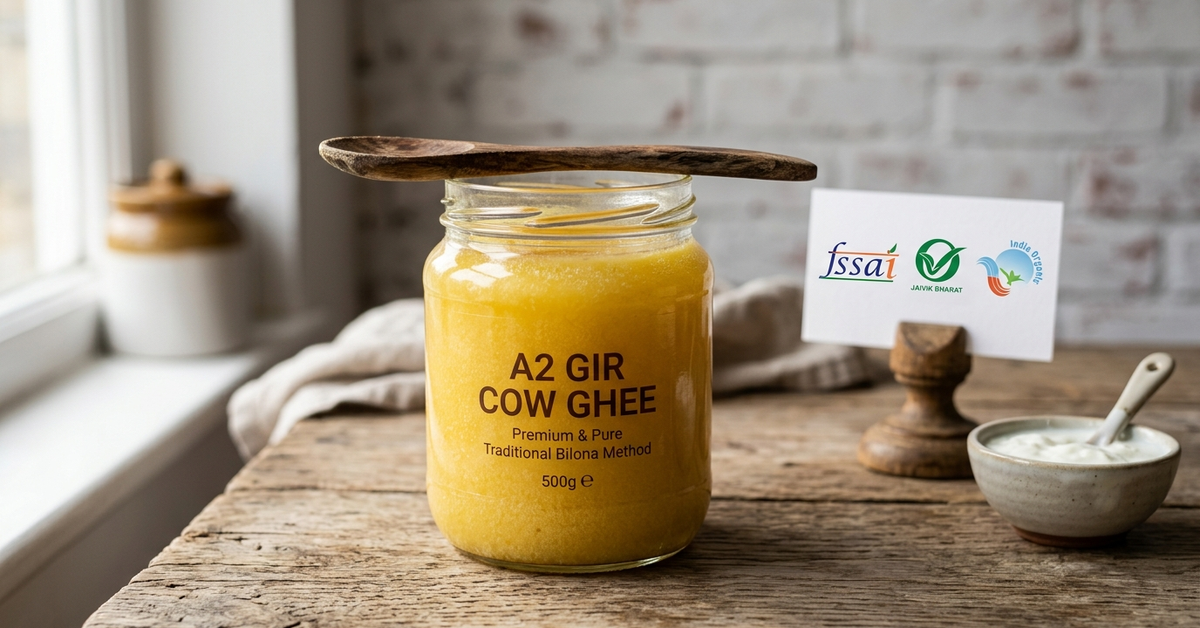
When you pick up a jar of Gir cow A2 ghee, the label tells a story. But how much of that story is backed by verifiable proof? At Goseva, we believe every claim about purity, breed, and processing method should be supported by evidence you can check yourself. The question worth asking is: what certifications should an authentic Gir cow A2 ghee brand have — organic, lab testing, or FSSAI compliance? The answer comes in layers, and understanding each one helps you make a confident purchase rather than relying on packaging hype.
FSSAI compliance forms the base and is legally required for food products sold in India. Third-party lab testing verifies A2 protein claims and screens for adulteration. Organic certification adds value but is required only if the brand explicitly markets its ghee as organic. A brand can sell legitimate A2 ghee without organic certification, but it cannot skip FSSAI compliance or ignore lab verification if it wants to earn your trust.
The Three Layers of Ghee Verification
At a Glance
- FSSAI compliance is mandatory for ghee sold in India. The previously cited Rs. 12 lakh turnover threshold for direct seller exemptions has reportedly been revised (to approximately Rs. 1.5 crore as of 2026); even under that threshold, sellers were exempt only from obtaining separate registration, not from FSSAI compliance entirely, as the main entity still needed a license. Street vendors are not exempt and require at least Basic FSSAI Registration.
- Organic certifications (NPOP, Jaivik Bharat) apply only if the brand claims organic status
- Third-party lab testing verifies A2 protein claims and detects adulteration
- A2 and organic are independent attributes requiring separate verification
- The Bilona method signals traditional processing quality but is not a formal certification
FSSAI compliance answers whether the product meets basic food safety standards. Lab testing answers whether the ghee genuinely comes from A2 protein sources and is free from adulterants. Organic certification answers whether the farming practices behind the milk avoid synthetic chemicals. Together, they give you a complete picture of what you are buying.
Mandatory Certifications for Gir Cow A2 Ghee Brands: FSSAI Compliance
FSSAI, the Food Safety and Standards Authority of India, is the primary regulatory body for all food products in the country, including ghee. Every ghee manufacturer must follow FSSAI standards before the product reaches store shelves or online marketplaces. The October 2024 FSSAI amendment removed the Reichert value restriction (sub-regulation 2.3.8) and Form A for ghee, which had previously required ghee with lower Reichert values to be sold under an Agmark seal. The amendment also removed AGMARK-related requirements for ghee, including the ghee-specific Reichert value restriction, and Form A was removed entirely. The amendment did not remove a BIS certification requirement for ghee specifically; BIS was removed for infant nutrition products and packaged drinking water. FSSAI licensing remains the core mandatory compliance requirement for manufacturing, storing, and selling ghee.
The FSSAI standard for Milk Fat Products (Regulation 2.1.8) defines ghee as a fatty product derived exclusively from milk or products obtained from milk, through processes that achieve almost total removal of water and milk solids-not-fat. For consumers, two compositional benchmarks matter most: moisture content must not exceed 0.5%, and milk fat must make up at least 99.5% of the product. Additional laboratory parameters support these standards, including a Butyro refractometer reading at 40 degrees Celsius between 40.0 and 44.0, a Reichert-Meissl value of at least 24.0, a Polenske value between 0.5 and 2.0, and Free Fatty Acids as oleic acid not exceeding 2.0%. FSSAI also prohibits the sale or use of admixtures of ghee with any substance prepared as an imitation or substitute for ghee, or containing any oil or fat not conforming to the definition of ghee.
A valid FSSAI license number must appear on every package, giving consumers a way to verify the brand’s regulatory standing. Selling ghee without FSSAI compliance is illegal and poses serious health risks. A brand operating without FSSAI licensing has no oversight of its manufacturing hygiene, no accountability for ingredient sourcing, and no obligation to meet compositional standards that protect consumers from adulterated or substandard products.
- Hygiene and manufacturing practices: FSSAI sets standards for cleanliness, equipment, and processing conditions in ghee production facilities
- Labeling requirements: Every package must display the FSSAI license number, ingredient list, nutritional information, and manufacturing details
- Compositional standards: Ghee must meet specific benchmarks for moisture (max 0.5%), milk fat content (min 99.5%), refractive index, and fatty acid values
- Adulteration prohibition: FSSAI regulations explicitly ban the sale of ghee mixed with any non-dairy fat, oil, or imitation substance
Organic Certifications: NPOP, Jaivik Bharat, and India Organic
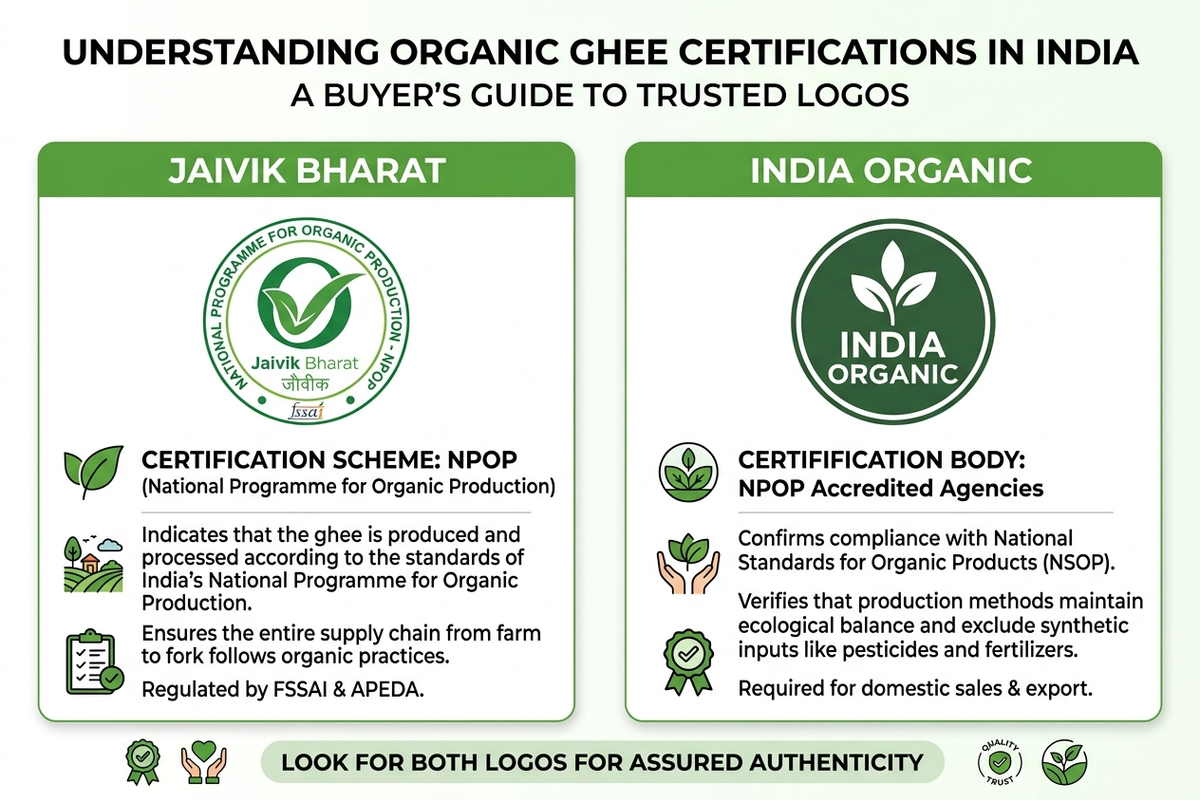
Organic certifications are not mandatory for all ghee. They become essential only when a brand claims its product is organic. In India, the Food Safety and Standards (Organic Foods) Regulations, 2017 recognize two systems: the National Programme for Organic Production (NPOP) and the Participatory Guarantee System (PGS-India). The Jaivik Bharat logo, jointly developed by FSSAI, APEDA, and PGS-India, serves as a unified identity mark to distinguish organic products from non-organic ones. It communicates adherence to National Organic Standards and functions as the primary visual cue consumers should look for on packaging.
The India Organic logo, a Government of India trademark managed by APEDA, is granted only to manufacturers and processors certified by accredited Certification Bodies under NPOP standards, now in their 8th Edition as of 2024. There are 28 Accredited Certification Bodies under NPOP, and these bodies oversee compliance at each stage of the production and labeling process. NPOP does not confer any right for use of the Jaivik Bharat logo, so consumers should check for the correct logo combination on the package. NPOP labeling requirements are strict: a product labeled “Organic” must contain 100% certified organic ingredients for single-ingredient products, or at least 95% certified organic ingredients for multi-ingredient products.
These certifications verify that the farming practices used to produce the milk avoid pesticides, synthetic fertilizers, and other chemical inputs. Organic foods in India are defined as products of holistic agricultural practices focusing on biodiversity, soil health, and chemical-free inputs with an environmentally and socially responsible approach. For a deeper look at why this matters, see our guide on why certification matters for Ayurvedic products. The key distinction to remember is that A2 refers to a genetic protein type in the milk, while organic refers to farming practices. They are independent attributes, and understanding this difference is essential when evaluating ghee certifications.
The Role of Third-Party Lab Testing for Purity and Authenticity
FSSAI compliance confirms that a ghee product meets regulatory safety standards, but it does not specifically verify A2 protein claims. FSSAI’s ghee standards apply generically to all ghee and do not have a separate, distinct regulatory standard specifically for A2 ghee. A2 is a marketing and quality differentiator verified through breed documentation and milk source testing rather than a separate FSSAI product category. Because the ghee-making process removes milk proteins during clarification, A2 protein verification typically relies on confirming the cow breed and testing milk at the source. That is where third-party lab testing becomes essential.
Independent laboratories analyze ghee samples against specific chemical, microbiological, and nutritional parameters to confirm purity and detect adulteration. NABL-accredited laboratories, accredited under ISO/IEC 17025:2017, serve as the benchmark for reliable testing in India. A Certificate of Analysis (COA) documents the results, and brands committed to transparency make these reports accessible to consumers. For an example of what a published COA looks like, one publicly available Intertek lab report for A2 Desi Cow Ghee from May 2025 showed milk fat at 99.92 g/100g, well above the FSSAI minimum of 99.5%, and moisture at less than 0.1 g/100g, far below the 0.5% limit. The same report confirmed a negative Baudouin test, ruling out sesame oil adulteration, and a Reichert-Meissl value of 28.26, exceeding the FSSAI minimum of 24.0.
These are the kinds of verifiable data points that separate genuinely tested products from those relying on marketing alone. When a brand publishes a comprehensive Certificate of Analysis from an NABL-accredited lab, consumers can review independent verification rather than relying solely on product claims. Look for reports that cover multiple parameters, from compositional analysis to microbiological safety, as a sign that the brand has invested in thorough testing.
Purity is not just a promise; it is verified through independent laboratory testing.
A guiding principle for evaluating A2 ghee certifications
- A2/A1 protein verification: Typically conducted on milk sources and through breed documentation, since the clarification process removes milk proteins from finished ghee
- Fatty acid profile: Gas Liquid Chromatography (GLC) analysis breaks down saturated, mono-unsaturated, and poly-unsaturated fatty acids
- Adulteration detection: Tests check for vanaspati, starch, soap, detergents, mineral oils, vegetable fat, and animal fat
- Microbiological safety: Screening for Salmonella, E. coli, Coliforms, Yeast and Mould, and Listeria monocytogenes
- Freshness indicators: Peroxide value, Free Fatty Acids (FFA), and Reichert-Meissl value assess rancidity and overall quality
Verifying A2 Authenticity and Breed Traceability
A2 is a genetic trait, not a farming method. It refers to the type of beta-casein protein found in milk from indigenous cow breeds like Gir, Sahiwal, Tharparkar, and Rathi. Verifying A2 authenticity goes beyond marketing claims. Breed traceability confirms the ghee actually comes from Gir cows or other recognized A2 breeds, and lab testing of milk at the source is the most reliable way to confirm the absence of A1 protein. Without documentation of breed and milk testing, any brand can print “A2” on a label without independent verification.
The Bilona method, a traditional hand-churning process that makes ghee from curd rather than cream, serves as an indicator of quality and traditional processing. FSSAI’s own ghee standard recognizes that ghee has “especially developed flavour and physical structure as a result of its method of manufacturing,” acknowledging that the production method shapes the final product. Atlas Lab defines A2 ghee as “specifically made from the superior quality and nutritionally rich milk of the indigenous cow breed or desi cow milk using traditional Bilona method, a hand churning method.”
At Goseva, every differentiator on our checklist maps to a specific buyer question. Our quality certified genuine products carry the FSSAI license number on the packaging, so you can verify our regulatory standing directly. Our 14+ years of experience with a Gaushala since 1960 means we document our breed sourcing from genuine Gir cows at every step, not just on the label. Our Gir-cattle conservation earned the ICAR–NBAGR Breed Conservation Award 2023 — independent recognition of that commitment. And our Gir Cow Ghee is made using the Bilona method, the traditional hand-churning process that FSSAI itself recognizes as shaping the final product’s character. To learn more, see our guide to authentic Gir cow Bilona ghee brands.
Distinguishing Between A2 Ghee and Organic Ghee
| Feature | A2 Ghee | Organic Ghee |
|---|---|---|
| Protein type | Contains A2 beta-casein from indigenous cow breeds | May contain A1 or A2 protein, depending on cow breed |
| What it certifies | Genetic trait of the cow breed | Farming practices (no pesticides, no synthetic fertilizers) |
| Verification method | Breed documentation and milk source testing (COA) | NPOP or PGS-India certification |
| Key logos | Certificate of Analysis from NABL-accredited labs | Jaivik Bharat logo, India Organic logo |
| Automatically organic? | No, unless separately certified | No, unless the cow breed is confirmed A2 |
| Separate certification needed | Yes, lab testing for A2/A1 protein at the milk source | Yes, organic certification from accredited body |
The distinction matters because consumers often assume that A2 ghee is inherently organic, or that organic ghee must come from A2 cows. Neither assumption holds. A2 ghee can come from cows fed conventional feed and raised with chemical inputs, while organic ghee can come from crossbred cows that produce A1 protein. Both claims require their own separate verification processes.
A brand selling authentic Gir cow A2 ghee that is also organic would need both breed documentation and lab testing for A2 protein, plus NPOP or PGS-India certification for organic status. When you see both certifications on a label, you can trust that the brand has invested in verifying both the genetic origin and the farming practices behind the product. For a practical comparison of how different brands stack up, see our honest comparison of top A2 Bilona ghee brands.
Consumer Checklist: What to Look for on the Label and Beyond
- FSSAI license number: Must be printed on the packaging; verify it on the FSSAI portal if possible
- Organic logos: If the brand claims organic, look for the Jaivik Bharat or India Organic logo
- Lab report availability: Check the brand’s website for a published Certificate of Analysis (COA) from an NABL-accredited lab
- Breed information: The label should specify Gir cow or another indigenous A2 breed, not just “cow”
- Manufacturing method: Look for Bilona method or hand-churned as an indicator of traditional processing
- Ingredient transparency: The ingredient list should be simple and clear, with no vague natural claims without supporting evidence
Red flags include missing FSSAI license numbers, vague “pure and natural” claims with no lab reports, no breed specification, and prices that seem too good to be true for genuine Bilona A2 ghee. If a brand does not publish a COA or make one available on request, that absence should prompt questions. The problem of mislabeling occurs when a Food Business Operator marks a product as organic while it contains non-organic ingredients or where organic production standards are not adhered to, making third-party verification critical.
When a brand provides accessible lab reports and clear breed traceability, it signals a commitment to transparency that goes beyond marketing. We encourage you to explore what we offer to see how transparency works in practice across our full range of Ayurvedic and Gir cow-derived products.
FAQ: Common Questions About Gir Cow A2 Ghee Certifications
Is FSSAI Compliance Mandatory for Authentic Gir Cow A2 Ghee?
Yes. FSSAI compliance is mandatory for all ghee sold in India. A valid FSSAI license number must appear on the packaging. The October 2024 amendment removed the Reichert value restriction and Form A for ghee, but FSSAI licensing remains the core requirement.
Does A2 Ghee Automatically Mean It Is Organic?
No. A2 refers to the beta-casein protein type in milk from indigenous cow breeds. Organic refers to farming practices that avoid synthetic chemicals. Both claims require separate verification.
How Can I Verify If a Ghee Brand Truly Contains A2 Protein?
Look for a Certificate of Analysis (COA) from an NABL-accredited lab. Note that A2 protein verification is typically conducted on milk sources and through breed documentation, since the ghee-making process removes milk proteins. Finished ghee testing focuses on purity, adulteration detection, and compositional parameters.
What Are the Key Organic Certification Logos for Ghee in India?
The Jaivik Bharat logo and the India Organic logo, both based on NPOP standards. Check for these only if the brand claims organic status.
What Is the Bilona Method and Why Is It Important for A2 Ghee?
The Bilona method is a traditional hand-churning process that makes ghee from curd rather than cream. FSSAI recognizes that the manufacturing method shapes the final product’s character, making Bilona an indicator of traditional processing quality.
Conclusion: Choosing the Most Authentic Gir Cow A2 Ghee
The hierarchy is clear: FSSAI compliance is mandatory, lab testing is critical for verifying A2 claims, and organic certification is optional but valuable if claimed. Buying from trusted brands that provide full transparency at every tier is the surest way to get authentic, pure ghee. At Goseva, our 14+ years of experience with a Gaushala since 1960 and the ICAR–NBAGR Breed Conservation Award 2023 for Gir-cattle conservation ground every jar in proven heritage. We empower rural gosalas and farmers, and our ghee is lab-tested and made without synthetic preservatives, so you can trust what you bring home.
If you want to understand how our ghee is made, read our detailed breakdown of Goseva’s Bilona A2 Ghee authenticity. Ready to experience the difference? Explore where you can buy authentic Gir cow ghee online and inspect the FSSAI license number, breed information, and Bilona method details on every Goseva label.
