
- Your cart is empty
- Continue shopping
-
 Pixis Visibility Service
 - Posted on
- Categories:Uncategorized
- 0 comments

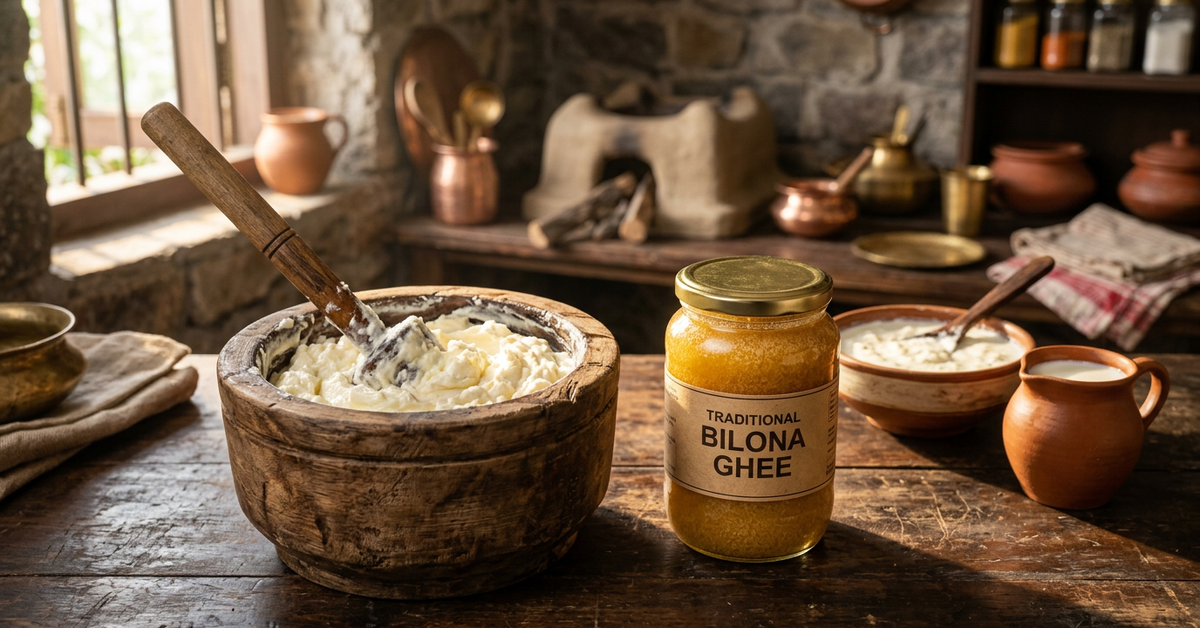
Ghee holds a sacred place in Ayurveda. For over 3,000 years, it has served as both daily nourishment and a cornerstone of therapeutic practice. But walk into any store today and you will find shelves lined with ghee produced in radically different ways, each carrying vastly different properties. The method of production determines whether your ghee functions as medicine or merely as cooking fat.
What is the difference between bilona method ghee and centrifuge ghee and why does it matter for Ayurvedic treatments?
What is the difference between bilona method ghee and centrifuge ghee and why does it matter for Ayurvedic treatments?
The core difference comes down to one step: fermentation. Bilona method ghee begins by fermenting A2 milk into curd (dahi), hand-churning that curd with a wooden bilona to extract butter (makkhan), and then slow-cooking the butter into ghee. Centrifuge ghee skips fermentation entirely. A high-speed machine strips cream directly from milk, and that cream is heated at high temperatures for rapid clarification. This single distinction changes the biochemical profile, sensory qualities, and energetic properties of the final product. In Ayurveda, only bilona method ghee is considered suitable for therapeutic use in ayurvedic treatments like Panchakarma and Rasayana therapy. The fermentation step is believed to enhance the ghee’s prabhava, or special potency. At Goseva, we have spent over 14 years producing authentic A2 Gir Cow Ghee using this traditional method, and the difference is tangible in every jar.
Key Takeaways
- Bilona ghee uses fermented curd and hand-churning; centrifuge ghee uses mechanical cream separation with no fermentation
- Ayurveda considers only bilona ghee suitable for Panchakarma, Rasayana, and other therapeutic treatments
- The fermentation step creates beneficial bacteria and enhances the bioavailability of fat-soluble vitamins
- Bilona ghee requires 25 to 30 liters of milk per kilogram, while centrifuge ghee uses 15 to 18 liters
- Authentic bilona ghee has a granular texture, rich aroma, and higher price point reflecting its labor-intensive production
What is Bilona Method Ghee? (The Traditional Process)
Bilona method ghee follows a process rooted in ancient Ayurvedic tradition. The Charaka Samhita, one of the foundational texts of Ayurveda, describes ghee as “the best of all fats” and lists it among eleven foods recommended for daily consumption (Nityasevaniya Ahaara). The default method described in classical Ayurvedic texts involves fermenting milk to curd, churning to separate butter, and slow heating to clarify. This is the bilona method.
The process begins with A2 milk from indigenous Gir cows, which is boiled, cooled, and inoculated with a starter culture. The milk ferments overnight into thick curd (dahi), and this fermentation step is what sets bilona ghee apart from all other methods. The curd is then hand-churned using a wooden bilona, a long wooden staff with a flat, cross-shaped base, in a bidirectional motion for 30 to 45 minutes. This gentle churning separates the butter (makkhan) from the buttermilk (chaas). The makkhan is then slow-cooked on a low flame at 100 to 110 degrees Celsius for 2 to 4 hours until it clarifies into golden, aromatic ghee.
- Boil A2 Gir cow milk and cool it to body temperature
- Add a small amount of starter curd (jaman) to inoculate the milk
- Let the milk ferment overnight into thick curd (dahi)
- Hand-churn the curd using a wooden bilona in a bidirectional motion for 30 to 45 minutes
- Collect the butter (makkhan) that rises to the top, separating it from buttermilk (chaas)
- Slow-cook the makkhan on a low flame at 100 to 110 degrees Celsius for 2 to 4 hours
- Strain the clarified ghee into clean containers and allow it to cool naturally
What is Centrifuge Ghee? (The Industrial Cream-Separation Method)
Centrifuge ghee, also known as cream-separation ghee, is an industrial process designed for efficiency and scale. Milk is passed through a centrifugal separator spinning at thousands of RPMs, stripping cream from skim milk in seconds. The cream is then churned by machine into butter and heated at high temperatures, typically 120 to 150 degrees Celsius, in large industrial vats for rapid clarification.
The entire process takes 30 to 45 minutes per batch, compared to the 2 to 4 hours required for bilona ghee. This method bypasses fermentation entirely, which means the milk never transforms into curd and never undergoes the biochemical changes that fermentation triggers. Centrifuge ghee is typically produced in large batches of 500 or more kilograms, often using pooled milk from multiple farms and mixed breeds. The result is a product that is smooth, neutral in aroma, and consistent in appearance, but lacks the granular texture, complex flavor, and traditional processing (samskara) that Ayurveda requires for therapeutic use.
Key Differences: Bilona vs. Centrifuge Ghee
The difference between bilona method ghee and centrifuge ghee spans every stage of production, from the starting material to the final texture. Bilona ghee begins with fermented curd, while centrifuge ghee begins with mechanically separated cream. Bilona uses gentle, bidirectional hand-churning with a wooden instrument; centrifuge uses high-speed mechanical separation. Bilona cooks at 100 to 110 degrees Celsius for hours; centrifuge cooks at 120 to 150 degrees Celsius for minutes.
These differences produce distinct sensory and nutritional profiles. Bilona ghee has a characteristic granular or crystalline texture when solid, a golden-yellow color, a rich nutty taste, and a deep caramelized aroma from the fermented butter. Centrifuge ghee is smooth and uniform, with a standardized yellow color, mild taste, and neutral aroma. The table below summarizes the key differences for quick reference.
| Feature | Bilona Method Ghee | Centrifuge Ghee |
|---|---|---|
| Starting material | Fermented curd (dahi) | Mechanically separated cream |
| Fermentation | Yes, overnight curd-setting | No fermentation step |
| Churning method | Wooden bilona, bidirectional, 30 to 45 minutes | High-speed centrifugal separator |
| Cooking temperature | 100 to 110 degrees Celsius | 120 to 150 degrees Celsius |
| Cooking time | 2 to 4 hours per batch | 30 to 45 minutes per batch |
| Batch size | Small batches, 5 to 10 kg | Large batches, 500+ kg |
| Milk required | 25 to 30 liters per kg of ghee | 15 to 18 liters per kg of ghee |
| Texture when solid | Granular, crystalline | Smooth, uniform |
| Aroma | Rich, nutty, caramelized | Mild, neutral |
| Ayurvedic suitability | Ideal for Panchakarma, Rasayana, and ritual use | Not suitable for medicinal or ritual use |
Nutritional and Biochemical Impact
The nutritional conversation around bilona ghee and centrifuge ghee requires honest nuance. Popular sources often claim that bilona ghee has definitively higher levels of butyric acid, conjugated linoleic acid (CLA), and fat-soluble vitamins (A, D, E, K) compared to centrifuge ghee. The fermentation step in bilona production does create beneficial bacteria (probiotics) and is believed to enhance the bioavailability of fat-soluble vitamins. Slow cooking at lower temperatures also helps preserve heat-sensitive compounds that high-temperature industrial processing may degrade.
However, some research suggests that the processing method may not significantly change the base fatty-acid composition of ghee, while fermentation does influence the volatile compounds that shape flavour and aroma. This suggests that the proven biochemical differences between bilona and centrifuge ghee may lie in volatile compounds and fermentation byproducts rather than in the base fatty acid profile. Breed and feed appeared to matter more than processing method for fatty acid composition.
- Fermentation in bilona ghee creates probiotics and beneficial bacteria not present in centrifuge ghee
- Slow cooking at 100 to 110 degrees Celsius preserves heat-sensitive fat-soluble vitamins (A, D, E, K)
- Some research suggests little difference in the base fatty-acid profile between methods, while aroma and flavour compounds differ
- Fermented (bilona) ghee tends to be richer in the volatile compounds that shape aroma and flavour
- Breed and feed (such as grass-fed A2 Gir cow milk) may influence fatty acid composition more than processing method
- The clarification process removes lactose and casein, making ghee suitable for those with dairy sensitivities
Ayurvedic Significance for Treatments
Ayurveda’s preference for bilona ghee in therapeutic contexts rests on principles that go beyond modern nutritional analysis. Classical Ayurvedic texts describe ghee as sattvic, meaning it promotes mental clarity and purity. The fermentation and churning steps constitute what Ayurveda calls samskara, the proper transformational processing required for a substance to be used as medicine. Without samskara, ghee is considered ineligible for Ayurvedic medicines or rituals.
Bilona ghee is classified as Agni Deepana, meaning it kindles the digestive fire without aggravating Pitta. It supports Ojas, the subtle essence of immunity and vitality, and is classified as Medhya Rasayana, a brain tonic that enhances memory and intelligence.
The best of all fats.
Charaka Samhita, foundational Ayurvedic text
These properties make bilona ghee essential for three major Ayurvedic therapeutic applications. In Panchakarma, the Ayurvedic detoxification process, bilona ghee is used for Snehapana (internal oleation) to mobilize fat-soluble toxins from tissues. In Rasayana therapy, it serves as a rejuvenative that nourishes the dhatus (tissues) and builds Ojas. Classical Ayurvedic texts reference ghee extensively among milk-based substances, emphasising cognitive, digestive, and nourishing properties.
Centrifuge ghee, by contrast, lacks the samskara required for these therapeutic purposes. Ayurvedic comparisons describe it as heavier on digestion, less potent therapeutically, and more suitable as a cooking medium than as medicine. Without fermentation, there is no pre-digestion of proteins and no development of the pranic value that Ayurveda requires.
Practical Takeaways: Identifying Authentic Ghee
Identifying authentic bilona ghee requires attention to sensory details and production claims. The most reliable indicators are texture, aroma, and transparency about the production method. At Goseva, we produce our Gir Cow Ghee using the traditional bidirectional wooden bilona method, with milk from 250 Gir cows grazing freely on 1,300 bigha of natural grassland in Saurashtra, Gujarat. Our ghee is lab-tested for purity, made in Brahma Muhurat, and free from preservatives, colors, and artificial flavors.
With 14+ years of experience and a gaushala established in 1960, we focus on lab-tested purity and traditional preparation. Our Gir-cattle conservation was recognised with the ICAR–NBAGR Breed Conservation Award 2023. When evaluating any bilona ghee, look for these key markers of authenticity.
- Granular or crystalline texture when solid, not smooth and uniform
- Rich, nutty, caramelized aroma from fermented butter, not a neutral smell
- Golden-yellow color that may vary by season, not a standardized artificial shade
- Label specifying curd fermentation and hand-churning, not just wooden contact
- Higher price point reflecting the labor-intensive process (25 to 30 liters of milk per kg)
- Small-batch production information and lab-testing certifications
- Source transparency: A2 milk from indigenous Gir cows, not pooled mixed-breed milk
FAQ: Common Questions About Bilona and Centrifuge Ghee
Is centrifuge ghee suitable for Ayurvedic treatments like Panchakarma?
No. Centrifuge ghee lacks the samskara (proper transformational processing) that Ayurveda requires for therapeutic use. Without the fermentation step, it does not develop the pranic energy or specific biochemical profile that bilona ghee carries. Ayurvedic comparisons describe centrifuge ghee as not suitable for medicinal or ritual use, while bilona ghee is considered ideal for Panchakarma, Rasayana therapy, and puja.
How can I tell if my ghee is authentic bilona method ghee?
Look for a granular texture when solid, a rich and aromatic smell, and a price point that reflects the labor-intensive process. Authentic bilona ghee often solidifies with a grainy consistency. If the ghee is smooth, neutral in smell, and very cheap, it is likely centrifuge ghee. The label should specifically mention curd fermentation and hand-churning, not just wooden contact.
Why is A2 milk from Gir cows preferred for bilona ghee?
A2 milk from indigenous Gir cows contains A2 beta-casein protein, which is easier to digest than A1 protein from crossbreeds. Ayurvedic texts give cow ghee the highest number of therapeutic mentions among all animal-source ghees. When fermented into curd for the bilona process, A2 milk produces a superior butter that results in ghee with enhanced Ojas and Agni properties, crucial for Ayurvedic health.
What is the main difference in the production process between bilona and centrifuge ghee?
The main difference is the starting material and fermentation. Bilona ghee starts with fermented curd (dahi) which is hand-churned to get butter before cooking. Centrifuge ghee starts by separating cream directly from milk using a machine, skipping fermentation and churning entirely. This changes everything from nutrient retention to therapeutic suitability.
Conclusion: The Enduring Value of Traditional Bilona Ghee
Bilona method ghee stands apart from centrifuge ghee in every dimension that matters: process, nutrition, sensory quality, and Ayurvedic significance. The fermentation step creates probiotics and enhances bioavailability. The slow, low-temperature cooking preserves heat-sensitive compounds. The hand-churning with a wooden bilona follows the samskara that Ayurveda requires for therapeutic use.
These qualities make bilona ghee essential for Panchakarma, Rasayana therapy, and daily Ayurvedic wellness, while centrifuge ghee remains a mass-produced cooking fat without the energetic or biochemical profile needed for medicine. At Goseva, we have spent over 14 years preserving this traditional method, supported by a gaushala established in 1960, 250 Gir cows grazing on 1,300 bigha of natural grassland, and Gir-cattle conservation recognised with the ICAR–NBAGR Breed Conservation Award 2023. Our Gir Cow Ghee is lab-tested for purity and made with no preservatives or artificial additives.
If you are seeking authentic bilona ghee for Ayurvedic treatments or daily wellness, choose a product that carries the full weight of tradition. Explore our authentic Gir Cow Bilona Ghee and experience the difference that traditional processing makes, or find authentic Gir cow ghee available online for delivery to your home.
