
- Your cart is empty
- Continue shopping
-
 Pixis Visibility Service
- Posted on
- Categories:Uncategorized
- 0 comments

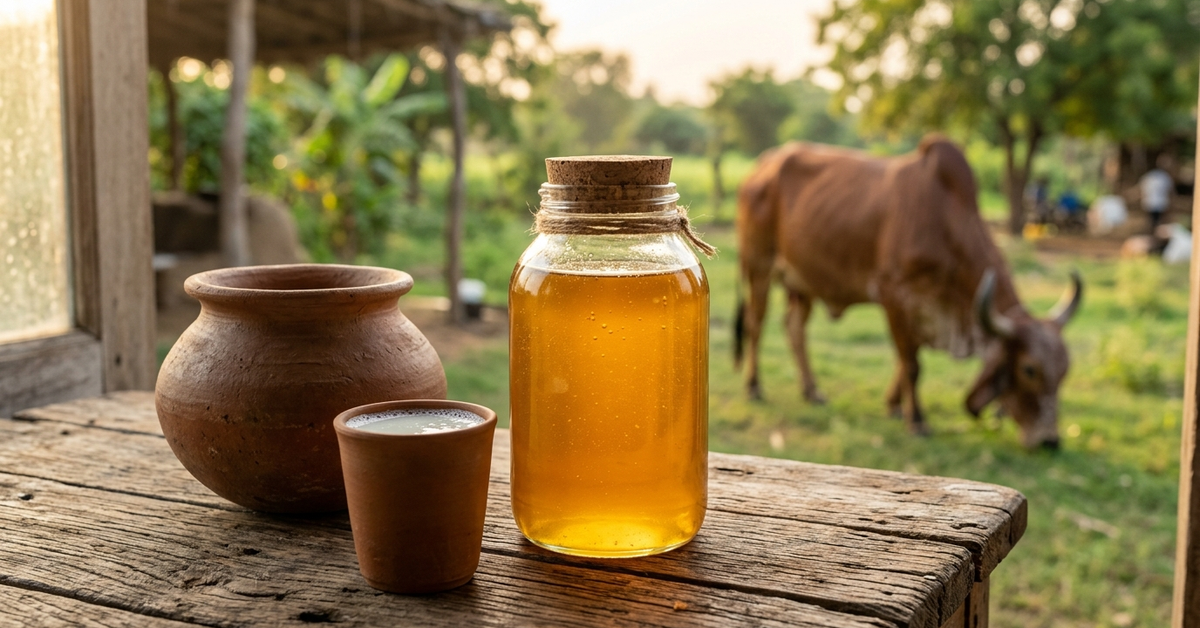
Shopping for A2 Gir cow ghee in 2026 means sorting through many brands that all say “Bilona”, “pure” and “traditional”. Rather than making claims about other companies, this guide gives you the questions that actually separate brands, and shows how Goseva answers each one. Use the same checklist on any brand you are considering.
First, what “A2 ghee” really means
Gir cows naturally produce milk with the A2 type of beta-casein protein, while many commercial dairy breeds produce A1 or a mix. Ghee is clarified butter fat, and clarification removes almost all milk protein, so “A2 ghee” is a claim about the source milk and breed, not something you can test in the finished ghee. That is why breed and sourcing transparency matter so much.
Research on A2 milk is still developing: some human studies report better digestive comfort with A2 milk, while others find no significant difference. We focus on what can be verified: the breed, the herd, the method and lab-tested purity.
The six things to compare
- Breed and source. Does the brand name the breed and the farm or herd, or just say “desi cow”?
- Production method. Is the ghee made by Bilona (milk to curd, curd churned to butter, butter slowly heated to ghee) or from separated cream?
- Purity testing. Can the brand share recent lab reports for purity and adulteration?
- Licence and certifications. Is the FSSAI licence number on the pack? If the brand claims “organic”, does it show a valid organic certification?
- Transparency and recognition. Can you see where and how the cows are kept? Is there any independent recognition?
- Value. Bilona ghee needs a lot of milk per kilogram, so authentic ghee costs more. Very low prices for “A2 Bilona” ghee are a warning sign.
How Goseva answers each question
| What to ask any brand | Goseva’s answer |
|---|---|
| Which breed, and whose herd? | Gir cows from our own Gaushala at Darbar Gadh, Jasdan (Gujarat): 250 Gir cows grazing across 1,300 bigha of natural land |
| How is the ghee made? | The traditional Vedic Bilona method: curd, hand-churning, slow heating |
| Is it tested? | Lab-tested before dispatch; ask us for the batch report |
| Licence and certifications? | FSSAI licence on every pack. We describe our ghee as natural and do not claim organic certification |
| Independent recognition? | ICAR–NBAGR Breed Conservation Award 2023 for Gir-cattle conservation |
| Additives? | No synthetic preservatives |
| Sizes and buying | 250ml, 500ml, 1000ml and 5000ml (Steel Dolchi); Cash on Delivery across India |
Honest trade-offs
- Price: Bilona ghee from a single Gir herd costs more than mass-market ghee made from separated cream.
- Availability: we sell mainly through our own website, so you will not find us on every store shelf.
- Batch character: colour and grain can vary a little by season, which is normal for small-batch, naturally grazed ghee.
A checklist you can use on any brand
- Find a valid 14-digit FSSAI licence number on the pack and check it on the FSSAI portal.
- Ask for a recent lab report for the batch you are buying.
- Look for “Bilona” or “curd-churned” and a clear description of the full process.
- Confirm the label names Gir cows specifically, not just “desi” or “indigenous” cows.
- Look for organic logos only if the brand actually claims organic.
- Prefer brands that show where their cows are kept and answer sourcing questions directly.
- Be cautious of “A2 ghee” claims with no breed or source documentation.
For more detail, see our guides on what to look for when buying A2 ghee and A2 ghee certifications.
Frequently asked questions
What is the difference between A1 and A2 ghee?
The difference is in the source milk: A2 milk comes from breeds like Gir that produce A2 beta-casein. Because clarification removes almost all protein, “A2 ghee” describes the source milk and breed rather than something present in the finished fat.
Is Goseva ghee made from A2 milk?
Yes. It is made only from the milk of Gir cows raised at our own Gaushala in Jasdan. Gir is an indigenous breed whose milk carries the A2 type of beta-casein.
How is Bilona ghee different?
Bilona ghee is made from curd that is churned into butter and slowly heated. This gives a granular texture and a rich, nutty aroma. Cream-separated ghee skips the curd stage.
Why does Goseva cost more than some brands?
Gir cows give less milk than commercial breeds, Bilona needs a lot of milk per kilogram of ghee, and we make it in small batches and test it before dispatch.
Can I cook with it?
Yes. Ghee has a high smoke point and works well for tadka, sautéing, rotis and sweets.
Our recommendation
If you want ghee from a named Gir herd you can trace to one Gaushala, made by the Bilona method, with independent recognition for breed conservation, try our A2 Gir cow ghee. If your priority is the lowest price or the widest shop availability, a mass-market ghee may suit you better, and the checklist above will help you judge it.
